
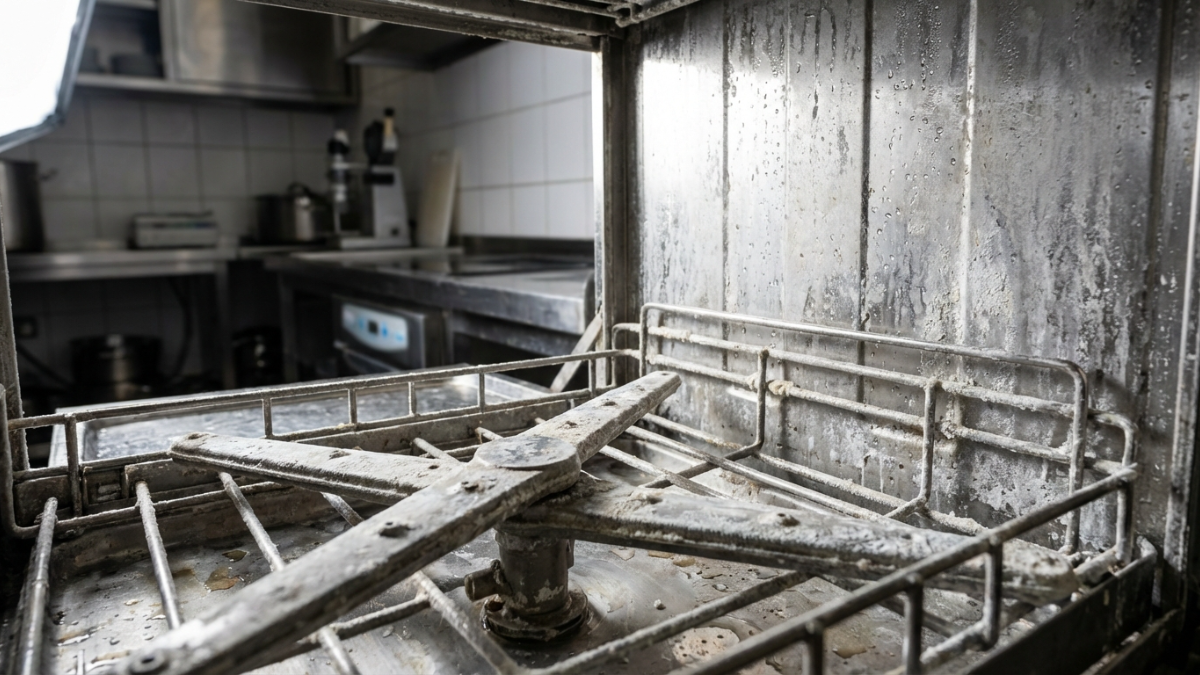

Scale prevention commercial dishwasher operators put in place at the inlet is the single most cost-effective intervention available in a busy commercial kitchen. From the moment hard water reaches a high-temperature wash tank, dissolved calcium and magnesium begin to precipitate onto heating elements, spray arms, and glassware, eroding cleaning performance and shortening equipment life. Sovereign Water specialises in protecting commercial warewashing equipment across hotels, restaurants, hospitals and contract caterers throughout the UK and the GCC region, combining British engineered pre-treatment with proactive Smart Maintenance.
This guide explains how scale forms inside a commercial warewasher, what the damage actually costs, and which water treatment approach delivers the best return for different site conditions. If you would like a site specific recommendation, our team is available for a free consultation and water quality assessment.
TL;DR
- Untreated hard water is the leading cause of premature failure in commercial dishwashers, attacking heating elements, spray arms, and final rinse jets.
- Even a 1 mm scale layer on a heating element can increase energy consumption by around 7 percent, raising utility bills and lengthening cycle times.
- Cloudy or filmed glassware is almost always a water quality issue, not a detergent issue, and damages guest perception in hospitality settings.
- The right treatment depends on your incoming water hardness, total dissolved solids, throughput, and machine type. Base exchange softening, reverse osmosis, and combined systems all have a place.
- Sovereign Water provides a free water quality assessment, fit-for-purpose specification, and Smart Maintenance support across the UK and the GCC.
In This Article
Why Scale Forms in a Commercial Dishwasher
Scale forms in a commercial dishwasher because heat drives dissolved calcium and magnesium out of solution, where they crystallise onto the hottest surfaces inside the machine. Hard water carries these minerals at concentrations that the wash tank cannot hold once temperatures climb above 60 degrees Celsius, and the resulting limescale binds tightly to elements, jets, and stainless steel.
The chemistry is straightforward. Calcium bicarbonate, dissolved invisibly in cold mains water, decomposes when heated to form calcium carbonate, the chalky white deposit familiar to anyone who has descaled a kettle. In a commercial warewasher operating between 60 and 85 degrees Celsius across multiple cycles per hour, this reaction is constant and cumulative. The harder the incoming water and the hotter the cycle, the faster scale accumulates.
The UK has some of the hardest water in Europe. According to the Water UK regional summaries, large parts of the South East, East Anglia, and the Midlands sit above 200 milligrams per litre of calcium carbonate, classified as very hard. In practical terms, a busy hotel kitchen in London, Cambridge, or Reading will deposit several grams of scale per day from a single warewasher running unprotected mains water.
A 1 mm layer of scale on a heating element can increase energy consumption by approximately 7 percent, according to the Carbon Trust guidance on commercial kitchen efficiency.
Why Total Dissolved Solids Matter Too
Hardness is the most visible problem, but Total Dissolved Solids (TDS) also play a role in dishwasher performance. High TDS water leaves drying spots and films on glassware even when calcium has been removed, because other dissolved salts remain in the rinse water. Sites with TDS above 250 parts per million typically need a combination of softening and reverse osmosis to deliver streak-free results, particularly for glasswashing in upscale hospitality venues.
The Hidden Costs of Untreated Water
Untreated water in a commercial dishwasher creates four interlocking costs that rarely show up as single line items: accelerated equipment wear, higher energy bills, ruined glassware, and reactive maintenance call-outs. Together, these costs typically dwarf the investment required for proper scale prevention within the first eighteen months of operation.
Heating elements fail prematurely. Scale acts as a thermal insulator. When deposits build up on a stainless steel element, the heater works harder to reach setpoint, runs hotter at the surface, and eventually burns out. Most manufacturers recommend replacement of failed elements rather than descaling in situ, and labour and parts on a single element swap can run into several hundred pounds.
Spray arms and rinse jets clog. Limescale accumulates inside the small bores of spray arms and final rinse jets, distorting the spray pattern and reducing wash quality. Operators typically respond by extending cycle times or adding more detergent, which masks the symptom but accelerates the underlying damage. Eventually arms warp or jam and require replacement.
Glassware loses its sparkle. Filmed, cloudy, or spotted glassware is almost always a water quality problem, not a detergent problem. In a hotel restaurant or fine dining setting, dull glasses translate directly into negative guest perception and replacement costs that can run to thousands of pounds per year for a busy venue.
“Hard water is the most under-recognised cause of warewashing failure in UK hospitality. The first sign is usually cloudy glasses, but by then significant element and seal damage is often already underway.” Sovereign Water service engineering team observation.
Reactive maintenance becomes the norm. Sites without proper pre-treatment fall into a cycle of emergency call-outs, descaling visits, and unplanned downtime. Service costs balloon and operational disruption mounts, particularly during peak service when a failed warewasher cannot simply be taken offline.
How Scale Prevention Works in a Commercial Dishwasher
Scale prevention commercial dishwasher operators choose works by removing or modifying hardness minerals before water enters the machine, so calcium and magnesium never reach a temperature where they precipitate on hot surfaces. Three core technologies are used in commercial warewashing: base exchange softening, reverse osmosis, and combination systems that pair the two.
Base Exchange Water Softeners
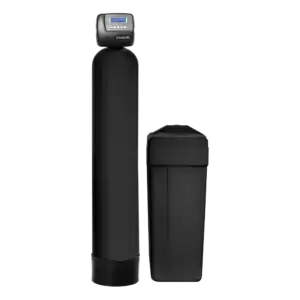
Base exchange commercial water softeners are the most common form of pre-treatment for commercial dishwashers. They use ion exchange resin to swap calcium and magnesium ions for sodium ions, producing soft water that will not deposit scale at any temperature. Modern commercial softeners are duplex or triplex configurations, which means service capacity is continuous: while one vessel is regenerating with brine, the others remain in service. This avoids any interruption to the warewasher supply during peak hours.
Base exchange softening removes hardness completely but does not change TDS. It is the right answer when hardness is the main problem and water taste, drying performance, and glass clarity are acceptable on softened mains water alone.
Reverse Osmosis (RO)
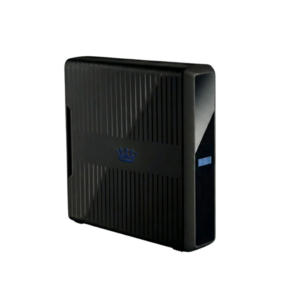
Our reverse osmosis units push water through a semi-permeable membrane that rejects up to 98 percent of dissolved solids, including hardness minerals, sulphates, chlorides, and silica. The result is near-pure water that leaves no residue when it dries. RO is the gold standard for glasswashing, particularly in upscale hospitality settings where streak-free presentation matters and where incoming TDS is high.
RO units have a higher capital cost than softeners and produce some reject water, so they are typically specified where the application demands it rather than as a default for every site.
Combined Softener and RO Systems
For high throughput sites with very hard water and high TDS, the most resilient approach is a combined system: a base exchange softener feeds the RO unit, protecting the membrane from scaling and extending its service life. Sovereign Water specifies and supplies both the softener and the reverse osmosis stages as a single integrated train, which is common in hotel chains, contract catering operations, and large hospital catering departments.
Bespoke Pre-treatment for Challenging Water
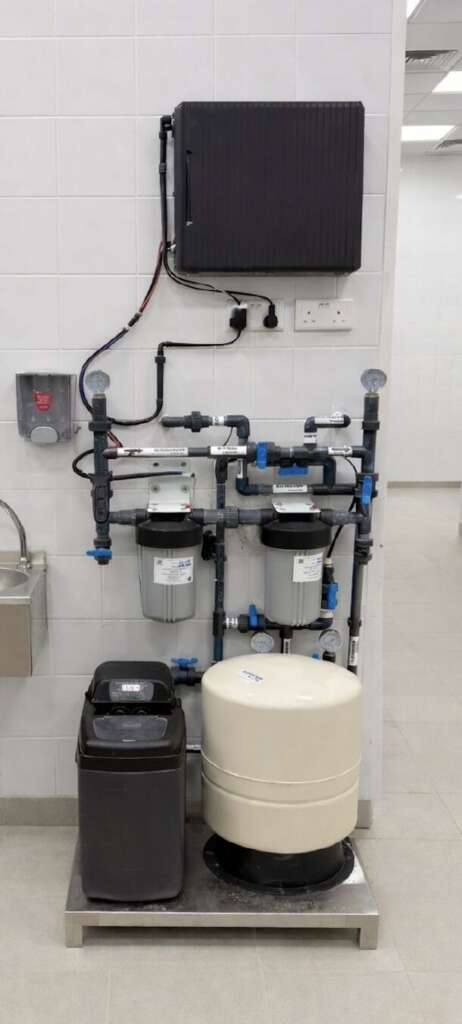
In regions where mains water is exceptionally hard, high in TDS, or contains elevated chlorides or silica, off-the-shelf solutions rarely deliver the right outcome. Sovereign Water designs and supplies bespoke pre-treatment trains that pair softening, multi-stage filtration, and reverse osmosis to match the specific water profile and the throughput demands of the warewasher fleet. This is particularly relevant for our work in the GCC region, where blended desalinated mains supplies require careful conditioning before they reach commercial kitchen equipment, and the same engineering discipline carries over to UK sites with unusually challenging local water.
Choosing the Right Treatment for Your Site
Choosing the right treatment for a commercial dishwasher starts with knowing your incoming water quality and your machine type. The four variables that drive specification are hardness, TDS, throughput in litres per hour, and the type of warewasher in use, whether undercounter glasswasher, passthrough hood, or rack conveyor.
Step One: Test the Incoming Water
Every site should begin with a free water quality test. Hardness, TDS, pH, chlorides, and silica all matter. A short on-site test takes minutes and removes the guesswork from specification. Sovereign Water includes this assessment in every site survey.
Step Two: Match the Machine
Glasswashers and dishwashers have different sensitivity to water quality. A glasswasher in a Michelin starred restaurant has near-zero tolerance for residue and almost always benefits from RO. A pot wash in a casual dining kitchen will perform well on softened water alone. Rack conveyors moving thousands of covers per service need throughput-matched softening to avoid running out of soft water during the dinner rush.
Step Three: Plan for Throughput and Regeneration
Commercial softeners are sized by daily soft water demand, not just peak flow. Undersized softeners regenerate too often, run out of capacity during service, and deliver hard water at the worst possible moment. The Sovereign Water engineering team sizes equipment for actual peak day demand, not nameplate ratings, and specifies duplex or triplex configurations where uninterrupted soft water is critical.
A correctly sized base exchange softener should regenerate during quiet hours, not mid-service. If your dishwasher is producing scale spots during peak times, the softener is almost certainly under-specified for the site.
The Sovereign Water Approach
Sovereign Water takes a fit-for-purpose approach to scale prevention in commercial warewashing, combining a free water quality assessment, British engineered specification, professional installation, and ongoing Smart Maintenance support. We have been protecting commercial kitchen equipment in the UK and across the Gulf for over two decades, and our engineering discipline applies regardless of how challenging the local water profile happens to be.
Free Site Assessment and Water Test
Every scale prevention commercial dishwasher project starts with an on-site water test and a discussion of the warewashing operation, including machine type, daily covers, peak service hours, and existing service issues. This drives a proposal that fits the site rather than a one-size-fits-all package.
Professional Installation
Our trained engineers install softeners, RO units, and combined systems with full pipework, electrical connections, and commissioning, including water quality verification at the warewasher inlet. We work around service hours wherever possible to minimise disruption, and we leave operators with clear documentation of the installed equipment.
Smart Maintenance Contracts
Our Smart Maintenance programmes use scheduled service visits, regenerant top-ups, membrane checks, and proactive component replacement to keep pre-treatment systems performing at specification. This means operators avoid reactive call-outs, glassware quality stays consistent, and warewasher equipment lasts the life expected of it.
Total Cost of Ownership and Payback
Total cost of ownership analysis consistently shows that scale prevention pays back within twelve to eighteen months for the average UK hospitality site. The savings come from reduced energy consumption, longer equipment life, lower detergent and rinse aid use, fewer service call-outs, and significantly reduced glassware replacement.
Energy Savings
Removing scale from heating elements restores the thermal efficiency they were designed to deliver. Multiplied across multiple wash cycles per hour and an annual operating year, the energy saving from scale prevention commercial dishwasher inlet treatment alone often funds the pre-treatment investment. Industry research from organisations such as the Catering Equipment Suppliers Association (CESA) and the Carbon Trust consistently identifies water treatment as one of the highest return interventions in commercial kitchen energy management.
Equipment Lifespan
Manufacturer warranties on commercial warewashers commonly require pre-treatment for installation in hard water areas, and failure to provide it can void cover. With proper treatment in place, undercounter and passthrough dishwashers routinely deliver 8 to 12 years of reliable service. Without it, the same machines often need major repair or replacement after 4 to 6 years.
Detergent, Rinse Aid, and Consumables
Soft water dramatically improves the performance of detergent and rinse aid because surfactants are not neutralised by hardness ions. Operators on softened or RO-treated water typically reduce chemical dosage by 20 to 30 percent while achieving better cleaning results. This is a recurring monthly saving that compounds across the life of the contract.
Glassware Replacement
For hospitality venues, glassware replacement is one of the most painful hidden costs of poor water. Permanent etching from prolonged exposure to hard, mineral-laden rinse water cannot be polished out. Quality, fit-for-purpose pre-treatment protects the glassware investment and the guest experience that depends on it.
Frequently Asked Questions
What is the best scale prevention solution for a commercial dishwasher?
The best solution depends on your incoming water profile and machine type. A base exchange water softener is the right answer for moderate hardness with acceptable TDS. Reverse osmosis is recommended for high-end glasswashing or high TDS supplies. Combined softener and RO systems suit high throughput sites with very challenging water.
How often should a commercial dishwasher water softener regenerate?
A correctly sized commercial softener should regenerate at most once per day, ideally during quiet overnight hours. If yours regenerates more often, or runs out of soft water during service, the unit is under-specified and the warewasher is being exposed to hard water at the worst possible time.
Can I just use a chemical descaler instead of pre-treatment?
Periodic chemical descaling can remove existing scale, but it does not prevent new scale from forming. Reactive descaling damages stainless steel surfaces over time, requires downtime, and never restores efficiency to the level achieved with proper inlet pre-treatment. Prevention is always cheaper than cure.
Will scale prevention void my dishwasher warranty?
The opposite is true. Most commercial dishwasher manufacturers require water within a defined hardness specification, and many will refuse warranty claims where unprotected hard water is identified as the root cause of failure. Properly specified pre-treatment protects both the machine and the warranty.
How much does commercial dishwasher pre-treatment cost?
Costs vary by site, throughput, and water profile. A typical undercounter glasswasher softener installation runs into low four figures, while a high throughput RO and softener combined system for a hotel kitchen sits higher. Sovereign Water provides a fully costed proposal after a free site assessment.
Ready to Protect Your Commercial Warewashing?
Sovereign Water provides free water quality assessments, fit-for-purpose pre-treatment specification, professional installation, and Smart Maintenance support across the UK. Protect your equipment investment, control your operating costs, and deliver consistently sparkling glassware.