
UV water disinfection commercial operators rely on works by exposing flowing water to germicidal ultraviolet light, damaging the DNA and RNA of bacteria, viruses, and protozoa so they cannot reproduce. For commercial sites running food and beverage operations, hospitality venues, healthcare facilities, schools, and any building where microbial risk is part of the duty of care, a properly specified UV system is one of the most reliable secondary barriers available, and one of the simplest to operate once installed correctly.
At Sovereign Water, we design, supply and maintain UV disinfection solutions across the United Kingdom, including our British-engineered SovereignSafe UV range. This article explains how UV water disinfection works, where it fits in a commercial water strategy, how it pairs with upstream filtration, and how the SovereignSafe units are sized to real-world commercial flow profiles. Whether you are protecting a busy hotel kitchen, a multi-tenant office, or a manufacturing process, the principles below will help you specify with confidence. To discuss your specific application, visit our Smart Maintenance page.
TL;DR
- UV uses germicidal light (around 254 nm) to inactivate bacteria, viruses, and protozoa, including chlorine-resistant Cryptosporidium.
- It is chemical-free, adds no taste or odour, and leaves no disinfectant residual, so it is best used alongside filtration.
- Filtration removes particles, scale, and chemicals; UV inactivates pathogens. The two are complementary, not interchangeable.
- Correct sizing depends on flow rate, water clarity (UV transmittance), and the target UV dose, typically 30 to 40 mJ/cm² for potable applications.
- Sovereign Water’s SovereignSafe UV range covers commercial flows from small kitchens up to 2.9 m³/h, with free site assessment to size yours.
In This Article
How UV Water Disinfection Works
UV water disinfection works by passing water through a chamber where it is exposed to ultraviolet light in the germicidal C-band, typically around 254 nm, which disrupts the DNA and RNA of microorganisms and prevents them from reproducing. Because UV is a physical process rather than a chemical one, no taste, odour, or by-product is added to the water, and there is no contact time required beyond the few seconds the water spends in the reactor.
The active mechanism is straightforward. Microbial cells that cannot replicate cannot establish infection, so even though the organism is technically still present in the water, it has been rendered harmless. The dose required to achieve this depends on the organism, with most regulatory and industry guidance targeting around 30 to 40 mJ/cm² for potable water applications. As the United States Environmental Protection Agency notes in its Ultraviolet Disinfection Guidance Manual, properly designed UV reactors are highly effective against bacteria, viruses, and protozoa when the right dose is delivered consistently.
When to Use UV in a Commercial Water System
UV water disinfection commercial sites typically deploy is the right choice wherever microbial control matters but chlorine, ozone, or other chemical residuals are undesirable or impractical. The most common UK applications are food and beverage production, restaurant and café kitchens, hospitality kitchens and laundries, healthcare premises, schools and care homes, laboratories, and any building where Legionella and broader water-system hygiene risk must be actively managed.
The case for UV becomes especially strong against chlorine-resistant pathogens. The Centers for Disease Control and Prevention notes that Cryptosporidium is significantly more tolerant of chlorine than of UV, which is why UV is widely deployed as a secondary barrier in any system at risk of protozoa contamination. For operators who depend on bore-hole or private supplies, recovered rainwater, or any source where microbial integrity cannot be guaranteed all the way to the tap, UV is often the most cost-effective way to add a robust final disinfection step.
“UV disinfection is a physical process that inactivates microorganisms without adding chemicals to the water, making it a strong fit for applications where taste, odour, or chemical residuals are concerns.” Source: US Environmental Protection Agency UV Guidance.
How UV Complements Filtration
UV inactivates pathogens but does not remove sediment, hardness, iron, chemicals, or any other physical or dissolved contaminants. Filtration removes those contaminants but does not in itself sterilise the water against viruses or chlorine-resistant protozoa. The two technologies are not interchangeable, and in any well-engineered commercial system they sit in series: filtration first, UV last.
The reason matters operationally. UV light cannot effectively pass through cloudy or particle-laden water, so high turbidity, iron staining, or organic colour will all reduce the delivered UV dose by lowering UV transmittance (UVT). In practice, this means commercial UV systems are almost always preceded by sediment filtration, scale management, and, where required, activated carbon for chlorine and organics. Sovereign Water’s water treatment specialists design the upstream stack to deliver the cleanest, most consistent water possible to the UV reactor, which in turn lets the UV system perform at its rated dose without overspecification.
The SovereignSafe UV Range
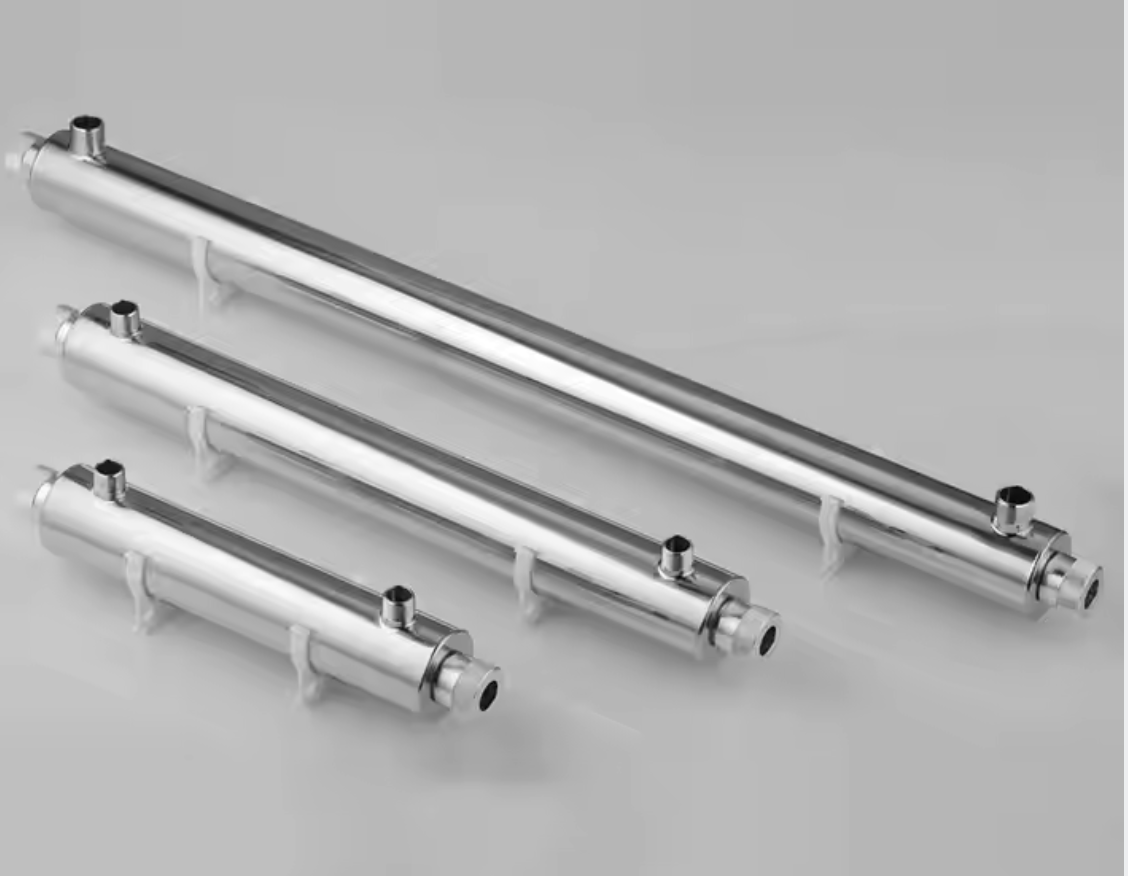
The SovereignSafe UV range is Sovereign Water’s own British-engineered series of UV water sterilisers, designed for the demands of UK commercial and residential applications. Each unit uses 254 nm germicidal UV-C lamps housed in a high-grade stainless steel chamber, eliminating up to 99.9% of bacteria, viruses, and protozoa from incoming water without any chemicals, taste impact, or by-products.
Three core sizes cover most commercial requirements:
- SovereignSafe SS-360: flow rate up to 1.2 m³/h, suited to small offices, single-outlet kitchens, and modest food preparation areas.
- SovereignSafe SS-480: flow rate up to 1.8 m³/h, suited to mid-sized restaurants, cafés, healthcare premises, and small hospitality operations.
- SovereignSafe SS-720: flow rate up to 2.9 m³/h, the largest in the standard range, designed for hotels, multi-kitchen sites, light industrial and high-throughput foodservice operations.
All three share the same engineering principles: stainless steel construction for durability and corrosion resistance, 9,000-hour UV lamp life on a simple annual replacement schedule, operating pressure of 2 to 6 bar, and the flexibility to be installed in horizontal or vertical configuration to suit the plant room. Combined with Sovereign Water’s Smart Maintenance programme, the SovereignSafe range delivers reliable disinfection performance with the lowest practical operational overhead.
SovereignSafe UV units eliminate up to 99.9% of bacteria, viruses, and protozoa, with no chemicals added, no taste impact, and no by-products in the treated water. Source: Sovereign Water product data.
Sizing, Dose and Design Considerations
Correct sizing of a UV water disinfection commercial system depends on three primary factors: peak flow rate through the unit, UV transmittance (UVT) of the incoming water, and the target UV dose set by the application. A typical potable water specification will aim for around 30 to 40 mJ/cm² to inactivate the broader range of waterborne pathogens, with higher doses for higher-risk applications or for organisms with greater UV resistance.
Peak flow is the most common point of under-specification in the field. A unit sized to average daily consumption will struggle during demand spikes, breakfast service in a hotel, lunchtime rush in a restaurant, or simultaneous draw across multiple outlets in a busy office. Sovereign Water sizes against the realistic peak, including a margin for future expansion. Where the source water has variable UVT, for example a borehole supply with seasonal organics or a building with intermittent iron carryover, we will specify additional pre-treatment to keep UVT above the design threshold for the reactor.
Total Dissolved Solids (TDS) and Pre-Treatment
While UV itself is unaffected by Total Dissolved Solids (TDS), high hardness can scale the quartz sleeve around the UV lamp, gradually reducing the dose delivered to the water. For sites with hard mains supply, particularly in the South East, East Anglia, and parts of the Midlands, Sovereign Water includes scale management upstream of the UV unit as part of a fit-for-purpose specification. This protects both the lamp output and the long-term reliability of the installation.
Operations and Maintenance
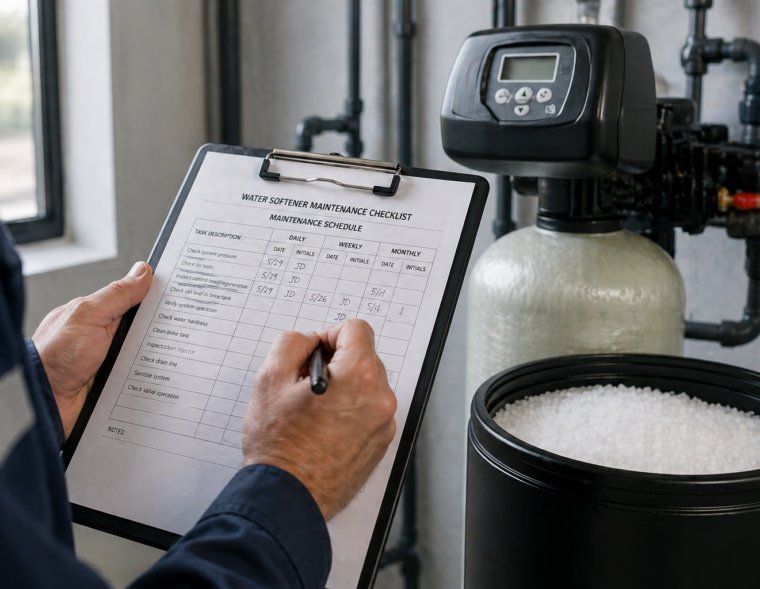
UV water disinfection commercial installations are mechanically simple compared with chemical dosing equipment, but they still require disciplined maintenance to keep the delivered dose where it should be. The principal items are annual UV lamp replacement, periodic quartz sleeve cleaning, monitoring of the UV intensity sensor, and verification that any alarm or low-dose interlock is functioning correctly.
Sovereign Water’s Smart Maintenance contracts package these tasks into a single scheduled visit cycle, with consumable supply, performance reporting, and rapid response support included. For multi-site operators this consolidates compliance evidence under one supplier, which simplifies water safety audits and Legionella documentation. The Health and Safety Executive’s L8 Approved Code of Practice for the control of Legionella bacteria in water systems sets out the broader duty-holder framework that UV maintenance fits within.
Limitations and Risk Management
UV is powerful but it is not a complete water treatment strategy on its own. Three limitations deserve attention at the specification stage. First, UV provides no residual disinfectant: as soon as the water leaves the reactor it can be re-contaminated downstream, so storage tanks, dead legs, and long pipe runs need to be designed and maintained accordingly. Second, UV does not address physical or chemical contaminants, so where the regulatory or operational risk includes lead, PFAS, hardness, sediment, or taste and odour issues, additional treatment is essential. Third, UV depends on lamp output and water clarity, which means routine monitoring, lamp replacement, and pre-treatment integrity are all part of the package, not optional extras.
The correct response is a multi-barrier strategy. In practice this means combining filtration, scale management, UV disinfection, and where appropriate a small chlorine or chloramine residual, each layer chosen to address a specific risk and sized against the realistic operating envelope. Sovereign Water’s water treatment specialists work with facilities, food safety, and engineering teams to put that strategy on paper before any equipment is ordered, so the finished system performs as expected from day one.
Frequently Asked Questions
What does UV water disinfection actually kill?
Properly dosed UV inactivates bacteria, viruses, and protozoa including chlorine-resistant Cryptosporidium and Giardia. The organisms remain in the water but cannot reproduce or establish infection, which is what makes them harmless to the end user.
Does UV replace filtration?
No. UV is a disinfection technology, not a filtration technology. It does not remove sediment, hardness, chemicals, or any physical contaminants. UV and filtration are complementary, with filtration upstream improving UV performance and UV handling pathogens that filtration cannot.
How often does a commercial UV lamp need replacing?
The SovereignSafe UV lamps have a rated life of 9,000 hours, equivalent to roughly one year of continuous operation. Sovereign Water includes annual lamp replacement and sleeve cleaning as part of every Smart Maintenance contract to keep the delivered UV dose on target.
Will UV protect against Legionella in my building?
UV at the point of entry or at strategic risk points can reduce Legionella bacteria in the treated water, but it does not protect the downstream pipework, tanks, or outlets. UV is one element of a wider Legionella control programme that should also address temperature, dead legs, and flushing regimes under HSE L8 guidance.
What size SovereignSafe UV do I need?
It depends on your peak flow rate, the quality of your incoming water, and the application’s target UV dose. The SS-360 covers up to 1.2 m³/h, the SS-480 up to 1.8 m³/h, and the SS-720 up to 2.9 m³/h. Sovereign Water carries out a free site assessment to confirm the right unit and any required pre-treatment.
Ready to specify UV for your commercial site?
Sovereign Water designs and maintains UV water disinfection systems across the UK, including our British-engineered SovereignSafe UV range. Our free site assessment confirms your peak flow, tests your incoming water, sizes the right unit, and packages it with Smart Maintenance so the disinfection performance stays where it should be year after year.