
RO membrane maintenance cleaning is one of the most searched topics among facilities teams running reverse osmosis systems, yet for most commercial installations the practical question is not how to scrub a membrane back to life but how to protect it, read its warning signs, and know precisely when to replace it. Reverse Osmosis (RO) membranes are consumable components: they degrade with use, and once performance falls away the right answer is usually a professional assessment and a planned replacement, not a chemical clean.
At Sovereign Water we supply, install and maintain RO systems across commercial sites in the UK and the GCC, and we see the same pattern again and again. The sites that get the longest, most reliable life from their membranes are the ones with correct pre-treatment and proactive servicing in place. This guide explains how RO membranes work, why they degrade, the signs to watch for, and the difference between industrial cleaning and the sensible replacement-led approach that suits commercial systems. If you would prefer a specialist to assess your system directly, our Smart Maintenance programme covers monitoring, servicing and timely replacement.
TL;DR
- RO membranes are consumables that lose performance through fouling, scaling, biofouling and chemical attack.
- The key warning signs are falling permeate flow, rising salt passage and increasing pressure drop across the membrane.
- Good pre-treatment is the single biggest factor in membrane life, especially in hard or high-TDS water regions.
- Chemical clean-in-place is an industrial-scale process; for commercial and point-of-use systems, planned replacement is the cost-effective route.
- Sovereign Water offers a free site assessment to check your pre-treatment, monitor membrane health and schedule replacements before performance fails.
In This Article
- How a Reverse Osmosis Membrane Works
- Why RO Membranes Degrade Over Time
- Warning Signs of a Failing RO Membrane
- The Effects of a Degraded Membrane on Your Operation
- Prevention: Pre-Treatment and Routine Maintenance
- Cleaning Versus Replacement: Industrial and Commercial
- When to Replace Your RO Membrane
- Frequently Asked Questions
How a Reverse Osmosis Membrane Works
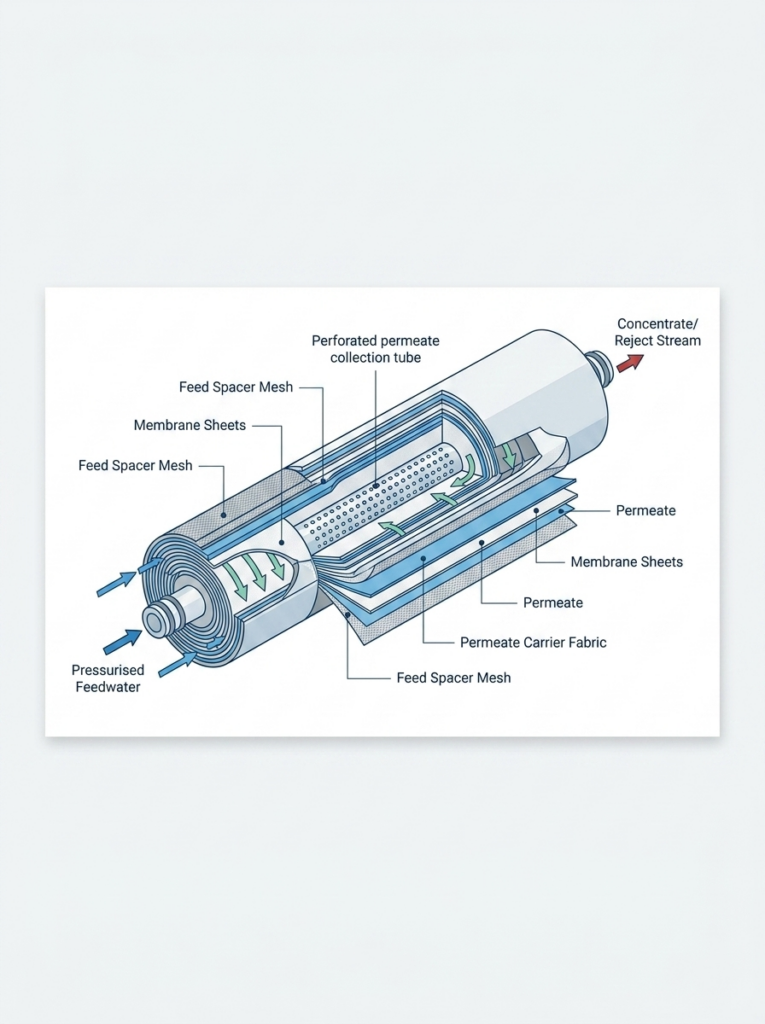
A reverse osmosis membrane is a semi-permeable barrier that separates dissolved salts and contaminants from water by forcing pressurised feedwater through it. Clean water, known as permeate, passes through the membrane, while a concentrated waste stream, the reject or concentrate, carries the rejected salts away to drain. This pressure-driven separation is what allows RO to remove the majority of dissolved solids from a supply.
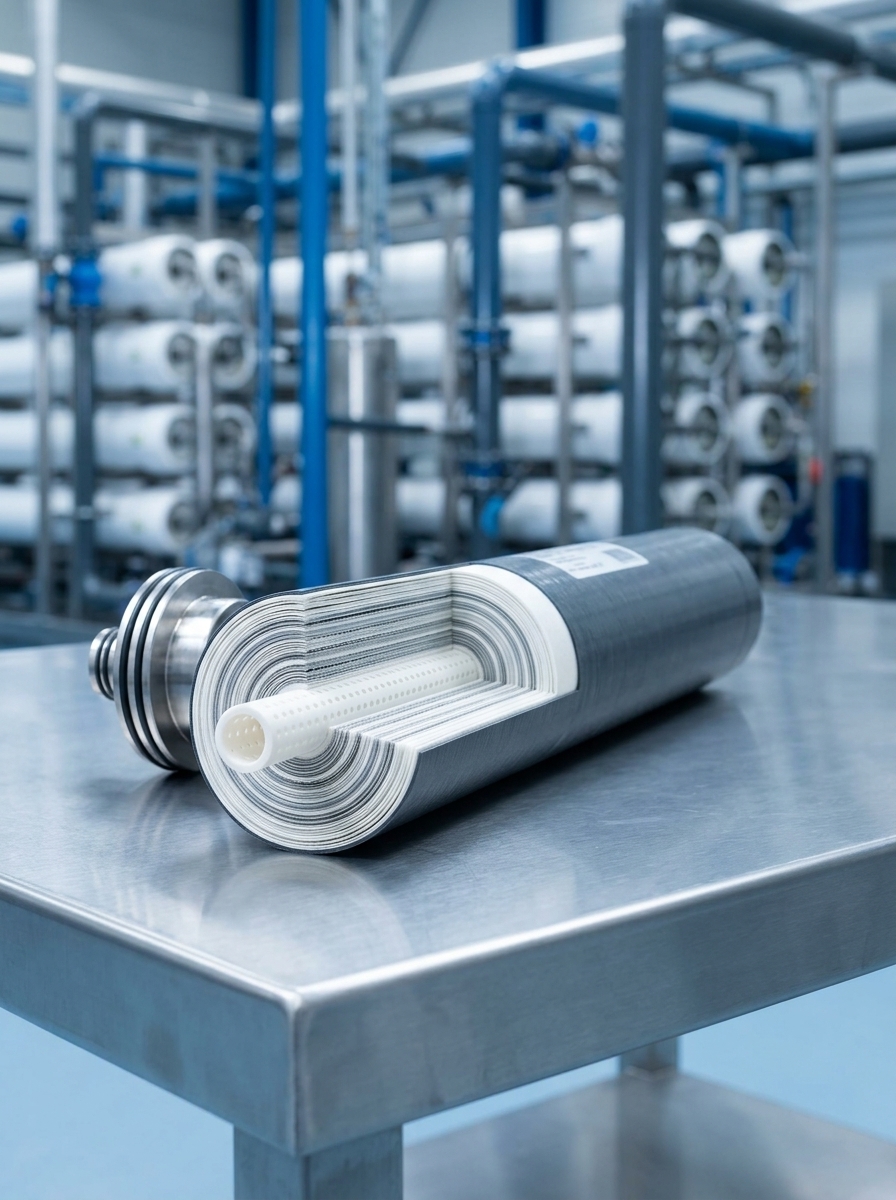
Inside a typical commercial element, the membrane is wound in a spiral around a central permeate tube, with feed water flowing across the surface rather than straight through it. Engineers judge how well a membrane is performing using three normalised measures: permeate flow (how much clean water it makes), salt passage (how much dissolved solid slips through), and pressure drop across the element. Normalisation simply means correcting these readings for temperature and pressure so that a genuine change in the membrane can be told apart from a change in operating conditions. Understanding these three numbers is the foundation of effective RO membrane maintenance cleaning decisions, because every degradation problem shows up as a shift in one or more of them.
Why RO Membranes Degrade Over Time
RO membranes degrade because the same surface that rejects contaminants gradually accumulates them. Four mechanisms are responsible: mineral scaling, organic fouling, biological fouling, and chemical attack. Each reduces flow, raises pressure drop, or worsens water quality, and most are driven by the quality of the feedwater reaching the membrane.
Scaling occurs when sparingly soluble minerals such as calcium carbonate and calcium sulphate precipitate onto the membrane as the feed is concentrated. This is a particular risk in hard water and high Total Dissolved Solids (TDS) regions, which is why feedwater chemistry matters so much. Organic fouling builds up from oils, proteins and natural organic matter, while biological fouling, or biofouling, is the growth of a living biofilm on the membrane surface. Chemical attack is different and often irreversible: free chlorine and other oxidants degrade the thin-film polyamide layer of the membrane, which is exactly why chlorine removal upstream is non-negotiable.
Drew Marine identifies three common types of fouling that affect RO membranes: scaling from inorganic minerals, organic fouling, and biological fouling, each requiring different prevention and treatment.
Importantly, degradation is cumulative. A membrane that is allowed to foul heavily for too long can reach a point where deposits become tenacious and the damage is permanent, meaning performance can no longer be recovered. This is the central reason a prevention-first strategy beats a clean-it-later one.
Warning Signs of a Failing RO Membrane
The clearest warning signs of a failing RO membrane are a measurable drop in permeate flow, a rise in salt passage that worsens product water quality, and an increase in the pressure drop across the element. Any one of these, tracked against the system’s normal baseline, indicates that the membrane is fouling, scaling or wearing out.
Industry guidance puts useful numbers on these thresholds. A widely used trigger across the sector is a 10 to 15 percent fall in normalised permeate flow, a similar rise in normalised pressure drop, or a 5 to 10 percent increase in normalised salt passage. On commercial systems you may notice this as slower tank refills, a higher TDS reading on the product water, or the system running longer to achieve the same output.
“At a minimum, RO/NF elements should be cleaned when: normalised permeate flow drops 10 to 15 percent; normalised permeate quality decreases by 10 to 15 percent; normalised pressure drop increases 10 to 15 percent.” — Sterlitech Corporation
The practical takeaway for most commercial operators is not to attempt remedial chemistry at this point, but to log the change and call in a specialist. These same indicators are also the data we use to decide whether a membrane is approaching the end of its serviceable life and should be scheduled for replacement.
The Effects of a Degraded Membrane on Your Operation
A degraded RO membrane has direct operational and financial consequences: poorer water quality, reduced output, higher energy use, and knock-on damage to downstream equipment. Left unchecked, a failing membrane quietly raises your running costs while undermining the quality the system was installed to protect.
When salt passage rises, product water TDS climbs, which can affect everything from beverage taste in a foodservice setting to scale protection for boilers, steamers and coffee equipment. When permeate flow falls, the system works harder and longer to meet demand, consuming more energy and water through the reject stream. In hospitality and food and beverage operations, inconsistent water quality can also create compliance and consistency problems that are far more expensive than the membrane itself. Viewed through a total cost of ownership lens, a tired membrane is rarely worth nursing along.
Prevention: Pre-Treatment and Routine Maintenance
Prevention is the most effective form of RO membrane maintenance, and it is overwhelmingly a question of pre-treatment. Protecting the membrane from scale-forming minerals, chlorine and particulates before water ever reaches it does more to extend membrane life than any cleaning regime carried out afterwards.
Effective pre-treatment typically combines sediment filtration to remove particulates, carbon filtration or dechlorination to protect the polyamide layer from oxidant damage, and scale control such as softening or antiscalant dosing in hard water. Prefilters are themselves consumables and need replacing on schedule, commonly every six to twelve months, to keep doing their job. This is where feedwater chemistry becomes decisive: a generic system that works in a soft-water area can fail prematurely in a high-hardness or high-TDS region.
This is precisely the problem Sovereign Water is built to solve. For challenging water regions we design and supply bespoke pre-treatment matched to the actual feedwater, so the RO membrane sees water it can handle and lasts as long as it should. British-engineered systems backed by our Smart Maintenance programme allow us to monitor performance, change prefilters on time, and flag a membrane for replacement before it fails rather than after. If you are unsure whether your current pre-treatment is fit for purpose, a free site assessment is the place to start.
Cleaning Versus Replacement: Industrial and Commercial
When it comes to RO membrane maintenance cleaning, it helps to be clear that cleaning and replacement are two different answers to two different situations. Chemical cleaning, properly called clean-in-place (CIP), is an industrial-scale procedure suited to large, multi-element systems where the cost of downtime and the value of recovery justify it. For most commercial and point-of-use RO systems, replacement is the sensible, cost-effective route.
On a large industrial plant, engineers will isolate a membrane train and recirculate carefully matched cleaning chemistry: typically an acidic cleaner for inorganic scale and an alkaline cleaner for organic and biological fouling, using chlorine-free water, controlled pH, low pressure and a controlled temperature, all kept strictly within the manufacturer’s limits. It is a precise, regulated process with detailed monitoring and maintenance logs behind it, not something to be attempted casually.
The DuPont FilmTec Cleaning Procedures Manual recommends cleaning when normalised permeate flow drops around 10 percent, normalised salt passage increases 5 to 10 percent, or normalised pressure drop increases 10 to 15 percent, always within defined chemical and temperature limits.
For the commercial systems most businesses run, the economics point the other way. The membranes are smaller and lower in cost, the equipment to clean them correctly is not on site, and attempting DIY cleaning risks oxidant or pH damage that finishes the membrane off entirely. A planned replacement by a trained technician restores full performance with certainty, protects your downstream equipment, and avoids the false economy of nursing a degraded element. This is the route we recommend and provide for the great majority of commercial installations.
When to Replace Your RO Membrane
You should replace an RO membrane when performance no longer recovers, when salt passage stays permanently elevated, when an element is physically damaged, or when it has simply reached the end of its economic life. These are the points at which further maintenance stops being worthwhile and replacement delivers the reliable outcome.
On commercial systems, the decision is usually clear once the warning signs covered above persist despite correct pre-treatment and on-schedule prefilter changes. A membrane that has suffered chlorine attack, for example, cannot be cleaned back to specification because the damage is to the membrane material itself. Rather than guess, our technicians use the system’s own flow, pressure and TDS data to time replacement so it happens proactively, during a planned visit, rather than as an emergency after a failure. That is the essence of our approach: protect the membrane with the right pre-treatment, monitor it through Smart Maintenance, and replace it on a planned schedule for consistent water quality and predictable cost.
Frequently Asked Questions
How long does a commercial RO membrane last?
With correct pre-treatment and routine servicing, a commercial RO membrane typically lasts two to five years, though this varies widely with feedwater quality. Hard water, high TDS or inadequate chlorine removal can shorten life considerably, while good pre-treatment extends it.
Can I clean my own RO membrane?
For commercial and point-of-use systems, cleaning is not recommended. Proper cleaning is an industrial clean-in-place process needing specific chemistry, equipment and controls. DIY attempts often cause irreversible damage, so planned replacement by a technician is the safer, more cost-effective choice.
What is the most common cause of RO membrane failure?
The most common causes are fouling and scaling from inadequate pre-treatment, and chemical attack from chlorine reaching the membrane. All three are largely preventable. Correct sediment, carbon and scale control upstream is the single biggest factor in protecting membrane life.
How do I know when my RO membrane needs replacing?
Watch for falling permeate flow, rising product water TDS and increasing pressure drop. A 10 to 15 percent change against the baseline is a recognised trigger. If performance does not recover after servicing, the membrane has reached the end of its life.
Does pre-treatment really make a difference?
Yes, significantly. Pre-treatment removes the particulates, chlorine and hardness that foul and damage membranes. In challenging water regions, bespoke pre-treatment is the difference between a membrane that lasts years and one that fails prematurely, which is why Sovereign Water designs it around your actual feedwater.
Ready to Protect Your RO System?
Sovereign Water designs bespoke pre-treatment, monitors membrane health through Smart Maintenance, and schedules replacements before performance fails, protecting your equipment and your water quality.