
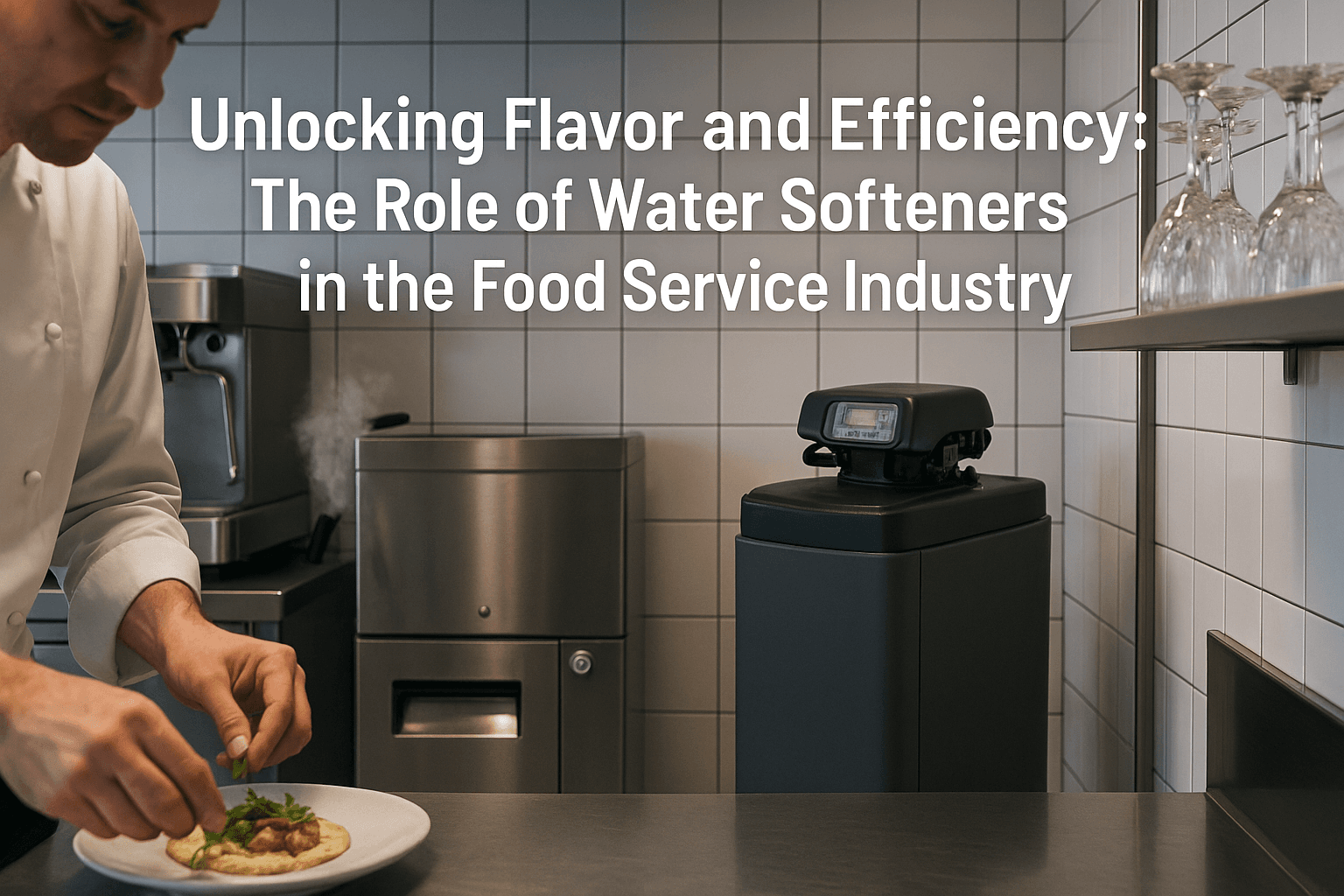
Unlocking Flavour and Efficiency: The Role of Water Softeners in the Food Service Industry
Table of Contents
- Understanding Hard Water Challenges in Food Service
- How Water Softeners Enhance Food Quality and Taste
- Protecting Kitchen Equipment: The Cost-Saving Impact of Softened Water
- Implementation Strategies: Selecting and Installing the Right System
- Sustainability Benefits: The Green Credentials of Water Softening
Understanding Hard Water Challenges in Food Service
For UK food service operations, water quality is a fundamental yet frequently overlooked component of success. Hard water, which contains high levels of calcium and magnesium minerals, creates significant operational challenges that silently undermine efficiency and quality across kitchens and cafes nationwide.
Much of England has hard or very hard water, particularly the south, east and Midlands, where the water passes through chalk and limestone. This geological reality creates persistent challenges for food service establishments operating in these regions.
Hard water manifests itself through several observable issues in commercial kitchens:
- Limescale buildup on equipment surfaces, particularly heating elements
- White, chalky residue on glassware and utensils after washing
- Reduced cleaning efficiency requiring more detergent usage
- Compromised flavour profiles in beverages and dishes
- Accelerated equipment deterioration and increased maintenance needs
For facilities managers and operational teams, these issues translate directly into higher operational costs, reduced equipment lifespans and inconsistent product quality.
The financial implications extend beyond equipment replacement. Increased detergent consumption, additional labour for descaling and emergency maintenance all contribute to an operational burden that compounds over time. For UK food service operations where margins are already tight, addressing water hardness becomes not just a quality consideration but a crucial economic decision.
How Water Softeners Enhance Food Quality and Taste
Water is a universal ingredient in practically every food service offering, from morning coffee to culinary creations and cleaning. The mineral composition of this fundamental ingredient directly influences final product quality in ways both subtle and profound.
Commercial water softeners work through an ion exchange process, replacing calcium and magnesium ions with sodium ions, removing the hardness that causes scale. This delivers several culinary advantages:
Enhanced Beverage Clarity and Taste
Speciality coffee and tea preparation are particularly sensitive to water chemistry. The Specialty Coffee Association's water standard targets total dissolved solids of around 150 mg/L (acceptable range 75 to 250 mg/L) and calcium hardness of about 68 mg/L. Water that is too hard creates bitter, inconsistent brews and leaves scale in equipment, while water with almost no minerals can taste flat, so coffee lines are usually treated to a target range rather than fully softened.
Improved Baking Results
Hard water strengthens gluten development in bread doughs, sometimes creating excessively tough textures. Properly treated water allows for more predictable, consistent baking results, which matters for establishments with standardised recipes across multiple locations.
Cleaner Flavour Profiles
The mineral content in hard water can mask or alter subtle flavour notes in dishes. Many chefs find that food prepared with softened water has a cleaner flavour, allowing good ingredients to express their full quality.
Enhanced Visual Appeal
Foods like vegetables can keep brighter colours when cooked in softened water. Similarly, sauces and soups can develop better clarity without the interfering mineral content.
For UK food service operations invested in quality and consistency, water softening represents a foundational improvement that elevates the entire culinary offering. As customer expectations continue to rise in competitive markets, this attention to water quality increasingly separates exceptional establishments from merely adequate ones.
Protecting Kitchen Equipment: The Cost-Saving Impact of Softened Water
The financial case for water softening in commercial kitchens extends far beyond taste improvements, with economic benefits coming through equipment protection and operational efficiency.
Equipment Lifespan Extension
Commercial kitchen equipment represents a significant capital investment. Hard water scale on heating elements, whether in commercial dishwashers, combi ovens, steamers or coffee machines, forces equipment to work harder, consuming more energy and failing sooner. Keeping scale off these parts is one of the simplest ways to protect that investment.
Energy Efficiency Improvements
The insulating effect of limescale on heating surfaces creates measurable energy inefficiency. The US Department of Energy notes that scale can increase fuel consumption in firetube boilers by up to 5%, and its figures show that ordinary scale just 1/16 of an inch (about 1.6 mm) thick causes a fuel loss of around 3.9%. For energy-intensive kitchen operations, that loss shows up directly on the utility bill.
A commercial kitchen in a hard water area that installs appropriate water softening can expect:
- Lower water heating costs as heating surfaces stay clean
- Less detergent needed to get the same results
- Less descaling labour and maintenance
Maintenance Reduction
Beyond the capital equipment savings, softened water reduces the operational burden of regular maintenance:
- Less frequent descaling of coffee machines and steamers
- Reduced emergency repair call-outs
- Lower chemical usage for cleaning and descaling
- Decreased equipment downtime
For facilities managers responsible for operational budgets, water softening represents one of the most straightforward efficiency investments available. The payback period depends on your water hardness, usage and equipment, so ask for a costed assessment before you buy.
Implementation Strategies: Selecting and Installing the Right System
Implementing an effective water softening solution requires thoughtful planning tailored to each food service operation's specific needs and water conditions. For facility managers and procurement teams, navigating these options demands a structured approach.
Assessment and Analysis
Before selecting any system, a water quality analysis is essential. This should evaluate:
- Water hardness levels (measured in mg/L or parts per million)
- Peak and average water usage volumes
- Space constraints for equipment installation
- Specific equipment requirements (some equipment may need particular water quality parameters)
System Sizing Considerations
Commercial water softeners are sized based on both flow rate requirements and total capacity between regeneration cycles. Under-sizing leads to incomplete softening during peak periods, while over-sizing creates unnecessary expense.
UK food service operations typically consider:
- Peak flow rate at the busiest service times
- Daily water volume across all connected equipment
- Some spare capacity for busy days and future equipment
Technology Options
Modern commercial water softening presents several technological approaches:
1. Salt-Based Ion Exchange Systems: The traditional approach using resin beds to exchange hardness minerals with sodium ions. These require regular salt replenishment but provide comprehensive softening.
2. Salt-Free Conditioning Systems: These systems don't remove minerals but alter their structure to reduce scaling. While technically not softeners, they can be appropriate for operations with moderate hardness concerns.
3. Reverse Osmosis Integration: For operations requiring highly purified water, RO systems may complement softeners by removing additional contaminants beyond hardness minerals.
4. Centralised vs. Point-of-Use Systems: Some operations benefit from whole-building treatment, while others may need specialised treatment only for specific equipment.
Maintenance Planning
Implementation should include a maintenance protocol covering:
- Salt replenishment schedules (for traditional softeners)
- Regular performance testing
- Periodic system sanitisation
- Integration with existing preventative maintenance programmes
For UK food service establishments, working with water treatment specialists who understand both local water conditions and commercial kitchen requirements is essential for selecting appropriately sized and configured solutions.
Sustainability Benefits: The Green Credentials of Water Softening
Beyond operational efficiency, water softening technology contributes to sustainability initiatives within UK food service operations, aligning with growing ESG commitments across the sector.
Energy Conservation
As noted above, scale prevention helps maintain heating efficiency. For operations with net-zero carbon commitments, lower energy use means a lower carbon footprint:
- Clean heating surfaces use less energy to reach temperature
- Reduced heating requirements contribute to facility-wide sustainability targets
Chemical Reduction
Hard water needs more cleaning chemicals to achieve the same results. Softened water enables:
- Lower detergent usage
- Decreased need for aggressive descaling chemicals
- Reduced chemical discharge into wastewater systems
- Lower environmental impact from chemical manufacturing and transport
Water Conservation
Scale-free equipment operates more efficiently, requiring less water for equivalent results:
- Dishwashers operate with fewer rewash cycles
- Steam equipment maintains optimal performance with less water
- Reduced equipment cleaning frequency conserves water
Extended Equipment Lifecycles
Perhaps the most significant sustainability benefit comes through extended equipment lifecycles:
- Longer equipment life reduces manufacturing resource demand
- Fewer replacement parts and equipment reduce embedded carbon
- Decreased equipment disposal and associated waste
For UK food service operations pursuing sustainability credentials, water quality management is a meaningful part of environmental strategy. Particularly when integrated with broader water management approaches, softening technology creates measurable environmental benefits that complement operational efficiencies.
Conclusion: The Strategic Value of Water Softening
For UK food service operations, water softening technology represents a strategic investment that delivers returns across operations, quality, sustainability and financial performance. While often overlooked in facility planning, water quality management increasingly distinguishes forward-thinking operations focused on efficiency and excellence.
The right water softening solution lets facilities managers, procurement teams and culinary leadership address several business objectives at once:
- Enhanced product quality and consistency
- Reduced operational and maintenance costs
- Extended equipment lifespan and performance
- Improved sustainability metrics
- Better alignment with modern ESG expectations
As resource efficiency and operational excellence become increasingly central to competitive success in the UK food service sector, water quality management, particularly through effective softening technology, is an accessible, proven way to address several business priorities with a single investment.
Talk to Sovereign Water
Improve your food service operation's efficiency and product quality with a tailored water softening solution from Sovereign Water. Our commercial systems are designed for UK food service environments, helping to protect equipment, save energy and improve culinary results. Contact our specialists to request a quote and recommendation.
To find out more, please contact the team at Sovereign Water using the phone number on our website or by emailing sales@sovereignwater.co.uk.
Sources
- US Department of Energy, Advanced Manufacturing Office: Clean Firetube Boiler Waterside Heat Transfer Surfaces, Steam Tip Sheet #7 (April 2012)
- Specialty Coffee Association: Water Quality Handbook