A commercial ice machine water filter does two jobs at once. It protects the machine from scale, and it protects the ice, which is food, from off-tastes and cloudiness. In much of England the incoming supply is hard, so an ice maker without filtration loses output as limescale coats the evaporator. This guide explains how the Everpure Fibredyne FC range handles ice and coffee duty, how to size it for a UK site, and what to expect from servicing.
TL;DR
- Ice counts as food under UK food hygiene rules, so the water that makes it matters as much as the machine.
- Everpure Fibredyne FC cartridges combine fine filtration, chlorine taste reduction and a built-in scale inhibitor on one head.
- Pentair rates the range from 6,000 to 100,000 US gallons, at 1.5 to 10 US gallons per minute.
- Size to your busiest hour, not your average day, or the cartridge becomes the bottleneck.
- Change cartridges by rated capacity and keep a log for your food safety file.
Planning ice or coffee filtration for a UK venue? Request a Quote and tell us your machines.
In this article
- Why ice quality starts with the water
- What UK hard water does to an ice maker
- How a commercial ice machine water filter works
- Sizing Fibredyne FC for a UK site
- When filtration is not enough
- Servicing and records
- Frequently asked questions
- Sources
Why ice quality starts with the water
In an iced latte or a gin and tonic, ice can fill half the glass. As it melts, whatever was in the water ends up in the drink. Chlorine gives a swimming-pool note. Sediment and dissolved air freeze into soft, cloudy cubes that melt fast and dilute the serve. Guests read cloudy ice as a hygiene warning, even when the machine is clean.
The Food Standards Agency's Safer Food, Better Business pack treats ice as part of food you serve, and expects cleaning and checks to be planned and recorded. A filter does not replace cleaning the bin and the machine. It does mean the water entering the machine is consistent, so the ice is too.
What UK hard water does to an ice maker
Hardness varies a lot across Britain. Your water company publishes the hardness for your postcode, and the Drinking Water Inspectorate oversees the quality of the supply. Large parts of the south and east of England are hard, while much of Scotland, Wales and the north west is soft.
On a hard supply, calcium carbonate drops out on the evaporator plate every freeze cycle. The plate then releases ice slowly, harvest cycles stretch, output falls and the compressor runs longer for less ice. Water distribution tubes and float valves block. Left long enough, the evaporator needs replacing, which is one of the costliest repairs on the machine.
Soft areas are not trouble-free. Chlorine taste still reaches the ice, and sediment from old pipework still clouds it.
How a commercial ice machine water filter works
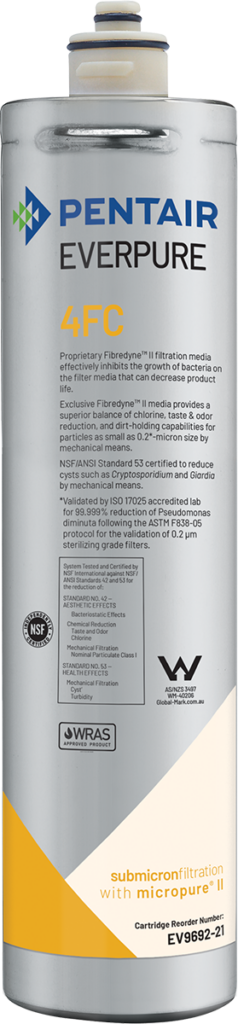
An Everpure Fibredyne FC cartridge sits on the cold feed to the ice machine or coffee equipment. Inside, Fibredyne media blends activated carbon with a fine fibre matrix, so it filters particles and reduces chlorine taste and odour in one pass. Pentair lists ratings from 5 microns down to 0.2 microns, depending on the model.
The cartridge also carries an integrated scale inhibitor. It does not remove hardness. It holds minerals in a form that is far less likely to deposit on hot or cold surfaces, which is what an evaporator or boiler needs. The media is bacteriostatic, meaning it inhibits bacteria growing on the filter itself.
Pentair states that Fibredyne media keeps strong flow for most of its life, rather than tapering off as many carbon blocks do. For ice, that means production stays steady right up to the planned change.
Sizing Fibredyne FC for a UK site
Pentair rates the FC range from 6,000 to 100,000 US gallons (about 22,700 to 378,500 litres), at flow rates from 1.5 to 10 US gallons per minute (about 5.7 to 37.9 litres per minute). Three things decide which head and cartridge you need.
| Question | Why it matters |
|---|---|
| How many machines share the line? | Combined flow at peak must stay within the cartridge rating |
| What is your local hardness? | Harder water uses up scale-inhibitor capacity faster |
| How much ice and coffee at the busiest hour? | Undersized cartridges restrict flow when you need it most |
A café with one espresso machine and one under-counter ice maker is usually served by a single head. A hotel with banqueting ice, a bar and several coffee points often needs a twin or triple manifold, so no one cartridge limits the others. Pentair's QC7I twin with two 4FC5 cartridges, for example, is rated at 30,000 US gallons at 5 US gallons per minute.
For ice-only duty, Everpure also makes dedicated Insurice systems. Our guides to the Everpure Insurice i2000 and the Insurice 4SI explain when those suit better.
Want help sizing the head and manifold? Talk to Our Team with your machine list and peak covers.
When filtration is not enough
Fibredyne FC filters and controls scale. It does not take out dissolved salts. Where a site wants crystal-clear gourmet ice, or very consistent coffee water, reverse osmosis is the next step. A Majestic RO system removes most dissolved solids, and the output can be blended back to the mineral level each machine needs.
RO suits flagship bars, cocktail venues and sites with very hard water feeding steam ovens as well. It needs drainage, space and more upkeep, so it is a choice to make on evidence, not by default. Our wider commercial kitchen water quality guide covers how ovens, glasswashers and dishwashers fit in, and our food and beverage water treatment page shows the full range for a commercial ice machine water filter set-up.
Servicing and records
FC cartridges are a sanitary quick-change design. The old one twists off and the new one twists on, with no need to open the system. A good install adds an inlet shut-off and a flush valve so every change is clean and quick.
- Change by rated gallons or the maker's time limit, whichever comes first.
- Clean and sanitise the ice machine to the manufacturer's schedule, alongside the filter change.
- Record the date, cartridge code and meter reading for your food safety file.
Our planned maintenance programme books cartridge changes against real usage, so a busy bar does not run out mid-service. A site survey is chargeable and lets our engineer confirm the head position, manifold size and any pre-treatment.
Frequently asked questions
Does a commercial ice machine need a water filter?
Yes, in almost every UK site. Hard water scales the evaporator, and soft water still carries chlorine taste and sediment into the ice. Most ice machine makers also expect filtration as part of good practice.
What is the difference between Fibredyne FC and Insurice?
Both are Everpure. Fibredyne FC is built for mixed coffee and ice duty. Insurice systems are designed for ice machines alone, with scale and slime control tuned to ice production.
How often should the filter be changed?
By its rated capacity in gallons or the maker's time limit, whichever comes first. Busy sites on hard water reach capacity sooner.
Will a filter make my ice clear?
It will make it cleaner and help it look clearer by removing sediment and chlorine. For fully clear, slow-melting ice, reverse osmosis is usually needed.
Can one filter feed my ice machine and coffee machine?
Yes, if the head is sized for both at peak flow. A twin manifold is often the safer choice on busy sites.
Clear ice, protected machines
Send us your ice machine and coffee machine models, your postcode and your busiest service. We will recommend the Fibredyne FC set-up and any pre-treatment, and send a quotation.
Sources
- Pentair, Everpure High-Performance FC Systems for Coffee and Ice
- Pentair Everpure, QC7I Twin 4FC5-S specification sheet
- Food Standards Agency, Safer Food, Better Business
- Food Standards Agency, Cleaning effectively in your business
- Drinking Water Inspectorate, Information for consumers