
A written water cooler maintenance schedule says what gets cleaned, changed and checked, how often, and who signs it off. For a UK business it covers the coolers and dispensers people drink from, and the treatment equipment behind them: filters, softeners, reverse osmosis (RO) membranes and UV lamps. This guide sets out a practical schedule, the faults to watch for, what a service contract should cover, and what skipping the work costs in downtime, callouts and risk.
TL;DR
- Wipe taps and drip trays daily, and sanitise the dispensing area weekly.
- Change filters on the manufacturer's schedule, usually about every six months, or sooner on heavy use or hard water.
- Book a professional sanitisation and descale at least once a year, and more often for busy machines.
- Keep a dated log. If something goes wrong, the log is your evidence that the work was done.
- Planned servicing is cheaper than emergency callouts, and it keeps your water cooler and treatment kit running when people need it.
Want the schedule written for your site and your machines? Talk to Our Team.
Why water cooler maintenance matters in a UK workplace
A water cooler is a food-contact appliance. Standing water, frequent hand contact at the tap and warm offices all help bacteria and biofilm to build up if nobody is looking after it. Scale is the second problem: in hard-water parts of the UK, limescale collects on heating and cooling parts and shortens their life.
There is also a legal side. Under the HSE's L8 Approved Code of Practice, the person responsible for a premises must assess and control the risk from legionella in its water systems. The HSE's HSG274 guidance explains the checks and records that go with that duty. A dispenser is only one small part of a building's water, but a written schedule and a dated log make it easy to show the whole system is managed.
The water cooler maintenance schedule, by frequency
Use this as a starting point and adjust it for your usage, your water and your manufacturer's instructions.
| How often | What to do | Who |
|---|---|---|
| Daily | Wipe taps, buttons and the front panel. Empty and rinse the drip tray. | Site staff |
| Weekly | Remove and wash the drip tray and grille. Sanitise the tap nozzles. | Site staff |
| Monthly | Check for leaks, slow flow, odd taste or smell. Check the filter change date. Review the log. | Facilities |
| Every six months | Change the filter cartridges. Sanitise the internal waterways on busy or high-use machines. | Service engineer |
| Yearly | Full sanitisation and descale. Replace the UV lamp if fitted. Inspect softener and RO equipment. | Service engineer |
The daily and weekly jobs take minutes. They stop most of the problems that lead to complaints. For a shared machine, name one person responsible and put a short checklist next to it.
What to service on each piece of equipment
Water coolers and dispensers need the surfaces cleaned, the filter changed and the internal waterways sanitised. Check the cooling and heating tanks for scale on a regular visit.
Filters are consumables. A carbon block filter that has reached its rated volume stops doing its job, and a neglected one can itself cause taste and odour complaints. Follow the cartridge rating rather than guessing from the calendar. Our guide to what a water cooler costs to run shows how filters and servicing fit into the running costs.
Softeners need their salt topped up and their resin and valves checked. RO systems need pre-filters replaced on time and the membrane checked for falling output. The membrane section of our guide to RO membrane maintenance explains the warning signs.
UV units protect the water only while the lamp is working. Manufacturers rate lamps for a fixed running life, commonly about a year of continuous use, so replace it on the date in your manual even if the lamp still glows. Our UV disinfection guide covers how the range works.
If dosing chemicals are used anywhere on site, the COSHH regulations apply to storing and handling them. The HSE's COSHH pages are the place to start.
Common water cooler faults, and what usually causes them
Most faults give a warning first. Learn the signs and you can book the visit before the machine stops.
- Water tastes of chlorine or smells stale: usually an exhausted filter, or water that has stood in a machine nobody uses.
- Slow flow or sputtering: scale or a blocked filter.
- Water not cold enough: dust on the cooling parts, a scaled tank, or a failing component. This one needs an engineer.
- Water pooling at the base: a worn seal or a loose connection. Switch the machine off and call for a visit.
- A pink or slimy film in the drip tray or around the tap: biofilm. Clean and sanitise straight away, and report it if it returns.
Keep a small stock of consumables
A short shelf of spares saves a lot of downtime. Keep a spare filter cartridge for each machine, food-safe sanitiser, cloths, and a spare drip tray and grille. Write the machine model and the filter part number on the shelf label, so that anyone can reorder the right item.
Choosing a cooler that is easier to look after
The simplest machine to maintain is one with a short, clear service routine and filters that are easy to reach. Two options from our range:
- CrownFlow, a mains-fed water cooler for offices, which draws water from the building supply, so there are no bottles to store or lift.
- BRITA Top Pro, a BRITA filtered dispenser. BRITA cartridges carry a rated capacity, which makes the change date easy to plan.
Not sure which suits your site? Request a Quote and tell us how many people use the machine.
Planned versus reactive maintenance
Reactive maintenance means you act when something has already gone wrong: a leak, a bad taste, a dispenser that stopped chilling on the hottest day. Planned maintenance means the same work is done on a fixed date before anything fails.
The cost of skipping the plan shows up in familiar ways:
- Emergency callouts take place at short notice, and the machine is out of use until the engineer arrives.
- Scale and exhausted filters shorten equipment life, so you replace machines sooner.
- Staff lose trust in the water, and drift back to bottles and kettles.
- When an auditor, insurer or client asks for records, there is nothing to show.
Under a planned programme the visits are diarised, so nobody has to remember them.
Servicing by use, not just by calendar
A fixed calendar is the minimum. Where the equipment supports it, data can improve it. Flow meters and filter-life counters show how much water has really passed through a cartridge, so a quiet office does not change filters early and a busy canteen does not change them late. Across several sites, the same readings let a facilities team see which machines need attention first.
This does not replace the engineer's visit. It helps decide when the visit is needed and what to bring.
What a service contract should cover
When you compare maintenance offers, check that each one states:
- which machines and treatment equipment are covered;
- the visit frequency, and whether callouts between visits are included;
- which parts are covered (filters, lamps, seals) and which are chargeable;
- whether sanitisation and descaling are part of the visit;
- the written service report you receive after each visit;
- response times for faults.
Our Comprehensive Maintenance programme is built around these points. Visits are planned, parts are replaced on schedule and each visit is recorded.
How to build your own schedule
- List every cooler, dispenser and piece of treatment equipment, with its model and install date.
- Note the manufacturer's service interval for each.
- Adjust for use: heavy use, hard water or a hot, busy kitchen all bring the dates forward.
- Put every date in a shared diary and name who is responsible.
- Keep a dated log for each machine and file the engineer's reports with it.
If you are unsure what your site needs, we can arrange a chargeable site survey. The survey looks at your equipment and how it is used. We specify the treatment for your supply, and we do not test or analyse your water. If you decide to go ahead with a project, the survey fee is credited against it.
Ready to put a plan in place? Request a Quote.
Frequently asked questions
How often should a water cooler be serviced?
Clean the surfaces daily and sanitise the dispensing area weekly. Change filters about every six months, or as the manufacturer states. Book a full professional sanitisation at least yearly, and twice yearly for busy machines.
How often should I change a water cooler filter?
Follow the cartridge rating from the manufacturer. For most mains-fed coolers that is about every six months. Change it sooner if flow slows, the taste changes or the machine is heavily used.
Can staff sanitise the machine themselves?
Staff can and should clean the outside, taps and drip tray. Internal sanitisation of the waterways is best left to a trained engineer with approved products, so that nothing is damaged and no residue is left behind.
Does a water cooler need a Legionella check?
A cooler is one part of the wider water system, and the duty under HSE L8 covers the whole premises. Include the cooler in your risk assessment and your written scheme, and keep records of what was done.
What happens if I skip maintenance?
Filters run past their rating, scale builds up, and the machine is more likely to fail without warning. You may also find you cannot show records when someone asks for them.
Ready to plan your water cooler maintenance?
Sovereign Water designs, installs and maintains water cooling and treatment equipment for UK businesses. Tell us what you have on site and we will recommend a practical schedule. Request a Quote.
Sources
- HSE, Legionnaires' disease: the control of legionella bacteria in water systems (L8)
- HSE, HSG274 Legionnaires' disease: technical guidance
- HSE, Control of Substances Hazardous to Health (COSHH)
- Drinking Water Inspectorate
Products mentioned in this article
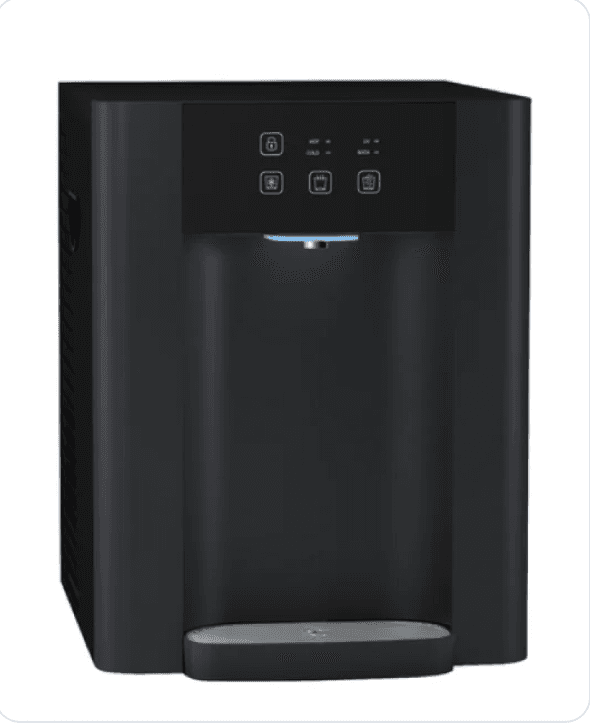
A sleek, compact countertop dispenser delivering instant chilled and ambient filtered water with commercial-grade…
View product →